Search Results
Search this site
151 results found with an empty search
- Connecticut River Races Return: The New England Paddlesports Championship & Community Challenge
The New England Paddlesports Championship (NEPC) is once again inviting racers and spectators to enjoy a competitive day on the Connecticut River! Canoe, kayak, SUP, and surf ski racers from across the Northeast compete for honors on New England’s historic Connecticut River between southwest New Hampshire and southeast Vermont. Racers can choose to run the 12-mile competitive course or the 5-mile recreational course. There will also be a 1-mile community challenge for those new to the sport. The course laps the Brattleboro-Hinsdale island by passing under the Rte. 119 bridges, where spectators cheer on competitors. NEPC is organized by Connecticut River Conservancy (CRC) and is part of the New England Canoe and Kayak Racing Association (NECKRA) Flatwater Point Series. Registrations are currently being accepted, with more details here. CRC and local partner organizations will organize on-site activities and info booths for spectators. Food and beverage trucks from J&B Curbside Care and Frisky Cow Gelato will also be parked and ready to serve. All activities will take place at Norm’s Marina in Hinsdale, NH, just over the bridge from Brattleboro, VT, on Sunday July 28th (with a storm date of the following Sunday, 8/4). Fees are topped at $20 for competitive racers, $10 for community challenge participants, and free for competing youth under 18 and all spectators. The morning begins at 10am with on-site activities, followed by the New England Paddlesports Championship (NEPC) race at 10:30, and the community challenge launching at 10:45. Over 60 racers are expected to compete in 12-mile and 5-mile loops right off the shore from Norm’s Marina. There will be an awards ceremony, humorous relay race, and knowledgeable conservation experts on hand to share information about the Connecticut River and restoration efforts to support clean water, healthy habitats, and resilient communities. "The NEPC is a wonderful opportunity for local communities and river-loving racers alike to enjoy a day on the water. The Connecticut River has a lot to offer, and we're excited to see folks come together, have fun, and maybe win a race!" says Kate Buckman, New Hampshire River Steward at Connecticut River Conservancy. After missing last year due to severe flooding, this is the 45th year of the popular race. Connecticut River Conservancy (CRC) will be joined by Brattleboro Reformer as an organizing and media partner, and other community partners. The event is generously supported by regional sponsors including the Savings Bank of Walpole, NorthStar Vermont Yankee Decommissioning, 802 Credit Union, Berkley & Veller Greenwood Country Realtors, and Reed & Reed among others. For all details, including a full schedule and race registration, visit the NEPC information page.
- Do Not Disturb Migrating Sea Lamprey!
It’s that time of the year again when we witness the migration of hundreds of thousands of migratory fish moving up the Connecticut River and its tributaries to spawn. Amongst them are the native sea lamprey. Sea lampreys return to our freshwater systems to spawn, or reproduce, after spending a few years in the ocean, as parasitic fish. Upon reaching freshwater systems, the lampreys stop feeding with only one goal in mind, finding suitable habitat to build their nests and lay their eggs. Lampreys will not seek to prey on humans or other organisms during their migration. After spawning, the lampreys die, leaving behind a nutrient rich carcass, providing numerous ecological benefits. In turn, larval lampreys burrow in sandy substrate and filter feed in the river, acting as cleaners like mussels. They will reside in the river for 5 years, developing into juvenile lampreys and moving to the ocean for their adult years. They are native to the Connecticut River, and we work to protect and restore their population and habitats. A separate population of sea lamprey are found in Lake Champlain and the Great Lakes, and are managed as a nuisance, or invasive, species. The two separate populations are managed differently and it’s important that the public understands this difference and does not interfere with their migration on the Connecticut River. As of May 30, 2024, close to 50,000 sea lampreys have made it over the Holyoke dam, compared to 22,000 total in 2023. They will be more noticeable below barriers, such as dams and culverts, and around rocky riverbeds. We ask that you please do not disturb them. Sea lampreys are managed by the Connecticut River Migratory Fish Restoration Cooperative, comprised of fisheries experts from state agencies from CT, MA, VT and NH, as well as federal agencies and representatives from the public. Learn more at www.migratoryfish.org
- What People Are Saying: Public Comments for Hydropower Relicensing on the Connecticut River
5 hydroelectric facilities on the Connecticut River are up for relicensing, and the public comment period is currently OPEN until May 22nd (after being extended from the previous April 22nd deadline). We have a once-in-a-lifetime opportunity to speak up for our rivers and influence licenses that will last for up for 50 years! If you’re new to the issue and looking for background information on the hydropower facilities, what’s at stake, or how Connecticut River Conservancy has focused our advocacy throughout this 12-year process, you can find all the details here. The Public Comments are Coming In Since the public comment period with FERC (the Federal Energy Regulatory Commission) opened on February 22nd, the comments have been pouring in from individual community members, towns, recreation clubs, and many different types of stakeholders who care about the Connecticut River. We're thrilled to witness an outpouring of engagement from individuals like you who are stepping up to protect our rivers. Here's What Some of You Are Saying: Lisa McLoughlin of Northfield MA O. Ross McIntyre of Lyme NH James Goedkoop of Wilder VT Sharon McDonald of Amherst MA Monica Jane Winters of New Salem MA Mike and Miriam Kurland of Williamsburg MA Thomas Collins of Chester VT The Town of Norwich VT Martha Bartlett of Wilder VT Steven Stocking of Fairlee VT Delegation of Western Mass State Reps There have been over 100 comments so far, and more are coming in every day. Comments range from being extremely short and to-the-point about issues or concerns, to being several pages long and full of scientific citations. Both are ok and valuable for FERC in this process. The more comments are submitted, the more we can ensure that all voices and perspectives are represented! To Read All Public Comments: All comments are open to the public. If you’d like to read all comments, or read comments based on the facility you are most interested in, here are the steps to access them on the FERC website. Go to the FERC website here Enter the docket number for the comments you’d like to see: Wilder Dam, P-1892-030 Bellows Falls Dam, P-1855-050 Vernon Dam, P-1904-078 Northfield Mountain Pumped Storage Project, P-2485-071 Turners Falls Dam, P-1889-085 Customize the date range or leave it as “all” since comment results will have the most recent comments at the top. This will bring you to a page full of comments. We hope they help show many examples for inspiration on your own comment submission! Next Steps: Writing Your Comments We want to extend a heartfelt thank you to everyone who has taken the time to submit their comments and speak up for our rivers. Your dedication and passion are inspiring and remind us of the collective power we hold to effect positive change. If you haven't yet added your voice to the conversation, there's still time! The public comment period remains open until May 22nd. Here’s what you can do: Review CRC’s hydropower details here See our FERC Comment Guide Reach out to our River Stewards for any questions or support with submitting your comments. Kathy Urffer: River Steward, VT 802-258-0413 | kurffer@ctriver.org Nina Gordon-Kirsch: River Steward, MA 413-834-9777 ngordonkirsch@ctriver.org Kate Buckman: River Steward, NH 603-931-2448 kbuckman@ctriver.org Thank you for being a champion of our rivers!
- Support for HB1649 and SB543 in New Hampshire for Healthier Rivers
Connecticut River Conservancy along with other organizations recently submitted testimony on legislation related to PFAS and environmental adaption. The organizations we signed with are: The Nature Conservancy, Appalachian Mountain Club, New Hampshire Association of Conservation Commissions, New Hampshire Rivers Council, New Hampshire Lakes, New Hampshire Audubon, Society for the Protection of New Hampshire Forests, Collaborative Solid Waste Strategies, League of Conservation Voters. April 23, 2024 The Hon. Kevin Avard, Chair Senate Energy and Natural Resources Committee State House Room 103 Concord, NH 03301 Re: HB 1649, relative to prohibiting certain products with intentionally-added PFAS Dear Chairman Avard and Honorable Committee Members, We, the undersigned organizations, are writing to express our support for HB1649. Because reducing the use of PFAS is essential to protecting the health of our communities and our environment, we urge the Senate Energy and Natural Resources Committee vote ought to pass on HB 1649 as amended by the House. PFAS are widespread and harmful to human health and the environment PFAS are a class of chemicals numbering in the thousands. They are highly toxic, causing the state to regulate four PFAS in drinking water and groundwater at the parts-per-trillion level. They are also highly persistent in human bodies and the environment, earning them the apt name “forever chemicals.” The harmful impacts of PFAS on human health are far-reaching and include certain cancers, liver and thyroid dysfunction, fertility issues, neurobehavioral disorders in children, obesity, and immunotoxicity. PFAS have been found in about half the country’s tap water. In New Hampshire, PFAS have been documented in at least 120 private wells and in public water systems. Humans are primarily exposed to PFAS through drinking water, eating fish, breathing contaminated air, and using consumer products that have PFAS. The costs of PFAS pollution are high The costs of cleaning up PFAS in our environment and addressing the adverse health consequences of PFAS are mounting and can be anticipated to reach into the tens of billions of dollars nationwide. New Hampshire and its municipalities have already begun to face the costs of testing and/or treating drinking water and wastewater for PFAS. Reducing PFAS at the source is essential to avoiding harm and solving the PFAS crisis Because they are so widespread, toxic, and persistent, PFAS must be addressed “upstream” by reducing them at the source. HB 1649 is essential to solving the PFAS pollution crisis—and to protecting the health of our communities and environment—since it prohibits the sale of ten categories of consumer products with intentionally-added PFAS. Without HB 1649, consumers cannot know if the products they purchase have these harmful chemicals and will continue to expose themselves and their loved ones unknowingly. PFAS in consumer products have contributed to PFAS pollution of waterways, drinking water, groundwater, air, and food sources, causing widespread exposures. Only through stemming the flow of these chemicals in the marketplace can we begin to tackle their environmental contamination and public health consequences. For these reasons, we strongly support HB 1649 and urge you to vote ought to pass. See the submitted testimony with the full list of signees here. April 24, 2024 Chairman Mark McConkey House Public Works and Highways Committee LOB Room 201-203 Concord, NH 03301 Re: SB543, establishing the state environmental adaptation, resilience, and innovation council Dear Chairman McConkey and Committee Members: We are writing to support SB543, establishing the environmental adaptation, resilience, and innovation advisory council. The undersigned groups work on a broad range of environmental issues in the state, including land conservation, forestry, water protection, clean energy, wildlife habitat, and recreation. We often work with municipalities and state agencies to advance our shared goals, and we are increasingly collaborating with them to both respond to and prepare for the impacts of extreme weather on our natural and cultural resources. From record-setting temperatures, to challenges for agriculture and recreation, to flooding and erosion, we are all dealing with resulting impacts to infrastructure, lands, and waters. We believe that the Council created in SB543 will help us all prepare for the future through a more comprehensive and strategic approach. Many of our groups are seeing the impacts of extreme weather on our own properties, and on the lands and waters that we work so hard to protect for the benefit of everyone in NH. We would welcome the opportunity to share our expertise and experiences with a state resilience council, and to support increased coordination and collaboration among state agencies, municipalities, nonprofits, and the academic community in addressing the challenges of becoming more resilient. We urge you to support SB543. It is a modest but important next step to increase New Hampshire’s resilience and preparedness for extreme weather. See the submitted testimony with the full list of signees here. Learn more about Connecticut River Conservancy's advocacy efforts throughout the watershed here.
- ECO AmeriCorps Position at Connecticut River Conservancy
Connecticut River Conservancy is thrilled to announce that we have been chosen to host an ECO AmeriCorp member this year. This service position would support Connecticut River Conservancy in efforts to assess watershed health, develop and implement stream restoration projects, support water quality testing, support volunteer groups taking part in our annual Source to Sea River Cleanup, support oversight and field work for the Connecticut River Paddlers Trail, and develop and implement public education campaigns to garner active engagement in watershed stewardship. See the full position description here. CRC staff member Kathy Urffer, Director of Policy and Advocacy and Vermont River Steward, will be supervising this position. She serves the Connecticut River and its watershed in the upper river from the MA border to the Canadian border in VT. Kathy is on the ground field staff working with landowners, federal and state agencies, and volunteers to protect the Connecticut River. Applications can be submitted through the AmeriCorp website.
- Tessellated Darters in the Connecticut River
You may have never heard of this little cutie, but the Tessellated Darter (Etheostoma olmstedi) is a pretty neat fish. It’s found in many river systems that drain to the Atlantic Ocean, from the St. Lawrence all the way to Florida. This includes our beloved upper Connecticut River watershed, where it is a native fish that spends its whole life in the river and tributaries. Tessellated Darters are in the same family as perch, but only get about three inches long at their largest. Snack-sized for larger fish like bass and eel, birds, and even turtles. Like their name implies, Tessellated Darters have a repeating pattern of spots which if you squint just right some say look like the letters W or M. Another distinguishing physical feature is a vertical black line running through the eye to the corner of the mouth, paired with another bar running from the eye forward to the tip of the nose. This coloration pattern likely helps them to be better camouflaged on the substrate, as they are benthic (bottom-dwelling) fish that prefer slower moving areas of water with muddy to sandy substrates with some small cobble. They eat benthic invertebrates and dietary studies have reported a preference for midge larvae, with caddisfly larvae becoming a more important food component in the fall. They move in rapid short spurts (ahem… darting!) when they are not sitting on the substrate. Some of these characteristics change temporarily during the spring breeding season. The male darter darkens in color and they seek out rockier areas. Eggs are laid on the underside of smooth rocks or submerged wood that has been cleaned by a male fish. The females may lay eggs in many nests and the males hang around to guard the nest full of fertilized eggs, one fish per nest, defending the eggs and keeping them clean until they hatch. Interestingly, Tessellated Darters have been reported to exhibit alloparental behavior, where the males tend to nests that are full of eggs fertilized by another male. And if I haven’t convinced you yet that these fish are pretty cool, remember back to when I wrote about mussels? And how interesting their life cycle is? Well… the Tessellated Darter is one of the host species for the endangered Dwarf Wedge Mussel, transporting the glochidia around in their gills. Which is why even though larger game fish and the (rightfully) celebrated migratory species get a lot of the spotlight, CRC also pays attention to what’s happening with these smaller species that have an equally important role to play in supporting a healthy ecosystem. They get considered when we are planning restoration projects, advocating for water quality improvements and habitat protection, or commenting on the effects of hydro operations or wetlands permits. So next time you see what looks like a “boring” minnow on the bottom of the river, just think… it might be a Tessellated Darter, guarding a nest or dispersing a mussel glochidia, and show it some appreciation.
- LiveStream: An Act of Congress - New Legislation to Protect our Watershed
At this LiveStream we celebrated Earth Day and the current Acts of Congress that may assist in protecting our great river and watershed. We heard from Kathy Urffer, Director of Policy and Advocacy at Connecticut River Conservancy; Markelle Smith from Connecticut River Watershed Partnership (formerly Friends of Conte); Jeremy Bratt, consultant; and Chris Curtis from the Deerfield River Watershed Association. Recorded 4/17/2024 _____________________ About LiveStream: CRC brings your rivers to you! Join CRC staff and partners for a series of live lunchtime presentations, on select Wednesdays from Noon-1pm. You get to learn more about the rivers you love, ask questions, and interact with a river-loving community all from the comfort and safety of your home (or wherever you may be). LiveStream will be hosted via Zoom. Please register for each presentation to receive meeting information. Check out CRC's Events Calendar to learn about other upcoming events.
- Farmington River Named One of America’s Most Endangered Rivers® of 2024
The Farmington River originates in southwestern Massachusetts and flows 81 miles until it reaches the Connecticut River in Windsor, CT. It is the longest tributary of the Connecticut River, and was designated a Wild and Scenic River in 1994. The Farmington River now faces a significant threat from the harmful and outdated Rainbow Dam. Today, American Rivers announced the inclusion of the Farmington River in its annual list of America’s Most Endangered Rivers®. “The Farmington River supports diverse fish and wildlife, is a vital source of clean drinking water for the region, and provides boating and other recreation opportunities, but this dam is an ongoing threat. This is an important moment for the river and an opportunity for Commissioner Dykes to continue her leadership in river restoration and environmental stewardship. We need Stanley Black & Decker to fix the problems it has created,” said Katie Schmidt with American Rivers. Eight miles upstream from where the Farmington River joins the Connecticut River is the Rainbow Dam, owned by Stanley Black & Decker. This small, poorly maintained hydropower dam has been in operation since the early 20th century, but due to a quirk of law, it has no federal oversight which has allowed it to damage the river for decades. “While hydropower contributes to our energy needs, this small and poorly maintained and unreliable dam is not necessary to New England’s energy needs. The insignificant energy it generates causes really big environmental problems,” noted Katie Schmidt. “Protecting the Farmington River is an important investment in our environment, our economy, and our quality of life. I fought for the river’s ‘Wild and Scenic’ designation, which unlocked thousands of federal dollars for conservation efforts, but there’s more we can do to protect and restore the watershed. I will continue to fight to keep our waters clean and healthy for generations to come,” said Senator Chris Murphy. The dam creates conditions in the upstream reservoir that repeatedly cause toxic algae blooms that can be a health hazard to people, and lethal to pets and wildlife, and degrades the water quality. In addition, the lack of federal oversight and limited state jurisdiction has allowed this small and poorly maintained hydropower project, whose inadequate and outdated fishway often led to fish mortality before it was shut down in 2023, to effectively render more than 95% of the watershed’s habitat inaccessible to river herring, shad, eel, and sea lamprey.“The time is now to act for the Farmington River,” urged Aimee Petras, Executive Director of Farmington River Watershed Association who nominated the river for Most Endangered Rivers. “Stanley Black and Decker has ignored Connecticut’s environmental laws and held the Farmington River hostage. The company has had well over a century of largely unrestricted use of the Farmington River’s resources–it is time for them to demonstrate respect for the river they benefited from and ensure future generations can enjoy it too.” American Rivers and partners called on the Connecticut Department of Energy and Environmental Protection (CT DEEP) and Stanley Black & Decker, to fix these problems for the health of the river as well as public health and safety. The power company has an unprecedented opportunity to tap into federal infrastructure funding to fix Clean Water Act violations, eliminate toxic algae blooms, and allow migratory fish populations to flourish again. "The Farmington River is vital to the environmental landscape of Connecticut and the 5th District in particular,” said Congresswoman Jahana Hayes. “I recognize the need to protect it, which is why I helped to secure a Wild and Scenic designation along the Farmington River for the Lower Farmington River and Salmon Brook during my first term in Congress. Protecting and restoring this fishery and recreation destination is of the utmost importance. I remain committed to working to protect this vital part of the region's environmental ecosystem." The Farmington River watershed covers over 600 square miles in Massachusetts and Connecticut. It holds two national Partnership Wild & Scenic River designations due to its remarkable values, and is a major tributary to the Connecticut River which spans across four states. The Farmington and its tributaries support cold-water resident fish species and habitat for various important migratory fish species. The watershed is a public drinking water supply for hundreds of thousands of people in the Hartford region. The West Branch of the Farmington is a highly regarded trout fishery. The river provides stretches of whitewater, used by individuals including world-class paddlers and outfitters, further adding to its cultural value as a coveted recreation destination. “Children and families rely on the Farmington River watershed for clean drinking water and a healthy, thriving regional ecosystem,” said Senator Elizabeth Warren. “Dam operators — like the Farmington River Power Company — must do better to protect aquatic life, combat toxic algae outbreaks, and ensure clean water for communities across the Commonwealth.” The annual America’s Most Endangered Rivers® report is a list of rivers at a crossroads, where key decisions in the coming months will determine the rivers’ fates. Over the years, the report has helped spur many successes including the removal of outdated dams, the protection of rivers with Wild and Scenic designations, and the prevention of harmful development and pollution. Other rivers in the region listed as Most Endangered in past years include the Ipswich River (2021), Hudson River (2019) and the Susquehanna River (2016). Within Connecticut, a river hasn’t made the list since 2004, when the Housatonic River was at risk with pollution. American Rivers reviews nominations for America’s Most Endangered Rivers® from local groups and individuals across the country, and selects rivers based on three criteria: 1) The river’s significance to people and wildlife 2) The magnitude of the threat to the river and communities, especially in light of climate change and environmental injustice 3) A decision in the next 12 months that the public can influence Learn more about the Farmington River and why it's Endangered. Take action here: Remove the Rainbow Dam | American Rivers. Local press coverage here. This article was adapted from a press release by American Rivers. American Rivers is championing a national effort to protect and restore all rivers, from remote mountain streams to urban waterways.
- Beaver Brook Dam Removal Project Update
Project update from Connecticut River Conservancy’s Restoration Director, Ron Rhodes, in Wilmington, Vermont. Also on site is Phillip Herzig, Fish Biologist and Maintenance Action Team Coordinator with U.S. Fish and Wildlife Service. Connecticut River Conservancy (CRC) is working with a private dam owner, the Town of Wilmington, the State of Vermont, and the U.S. Fish & Wildlife Service to remove an old mill dam and upgrade a town owned culvert to a new bridge. This project aims to restore water quality, reconnect native brook trout habitat, and improve flood resiliency in Beaver Brook (a tributary to the Deerfield River in the town of Wilmington). This dam and culvert are at an intersection of well-traveled roads, which were heavily impacted during Tropical Storm Irene. Ecological and community benefits include the following: Increased water flow, water quality, and oxygen levels for aquatic organism health. Increased aquatic organism passage (AOP), including native brook trout which require access to cold water habitats for reproductive spawning. Lower 100-yr flood elevation level by 7 feet. Eliminate the disruption of emergency services during future storm events. With special thanks to our funding partners: Watersheds United Vermont – VT Clean Water Block GrantUS Fish and Wildlife Service Flood Resilient Communities Fund – VT Vermont Watershed Grant Program Deerfield River Enhancement Fund State grant to town for dry hydrant work Video created and edited with sincere thanks to Jill DeVito and Charles Wright, of the Over the River and Through the Woods Youtube Channel. Additional photos showing some of CRC’s staff, the newly constructed bridge, and Beaver Brook downstream of project activity.
- Restoring Floodplains to Protect Against Flooding
With all the flooding this past year, it has been heart-wrenching to see the damage caused to our towns and communities. These floods have also illustrated the importance of our restoration projects in protecting against and reducing the damage caused by these floods. One example of this is the riverbank stabilization and floodplain forest restoration project that we completed in partnership with the Ammonoosuc Conservation Trust on their Ammonoosuc River Wildlife Management Area in Lisbon, New Hampshire during 2021-2022. In this project, we installed root wads (the roots and bottom 20' of large trees) along the river’s edge and lowered and terraced the riverbank behind the root wads. The root wads and terraces served to slow and divert the river’s flow and to give the river more room to spread out during floods. In addition, we also planted this old hay field with native trees and shrubs (2,182 plants on 6.8 acres). Although still small, these trees and shrubs are already working to hold the soil in place and to trap the sediment, debris (including large trees!), and ice carried by the river during last year’s floods. Although this is only one small project, implementing these types of restoration projects in critical locations not only protect these specific sites but also prevent sediment, debris, and ice from clogging culverts and bridges and damaging roads, houses, and businesses farther downstream. Find out more about Connecticut River Conservancy's restoration projects here.
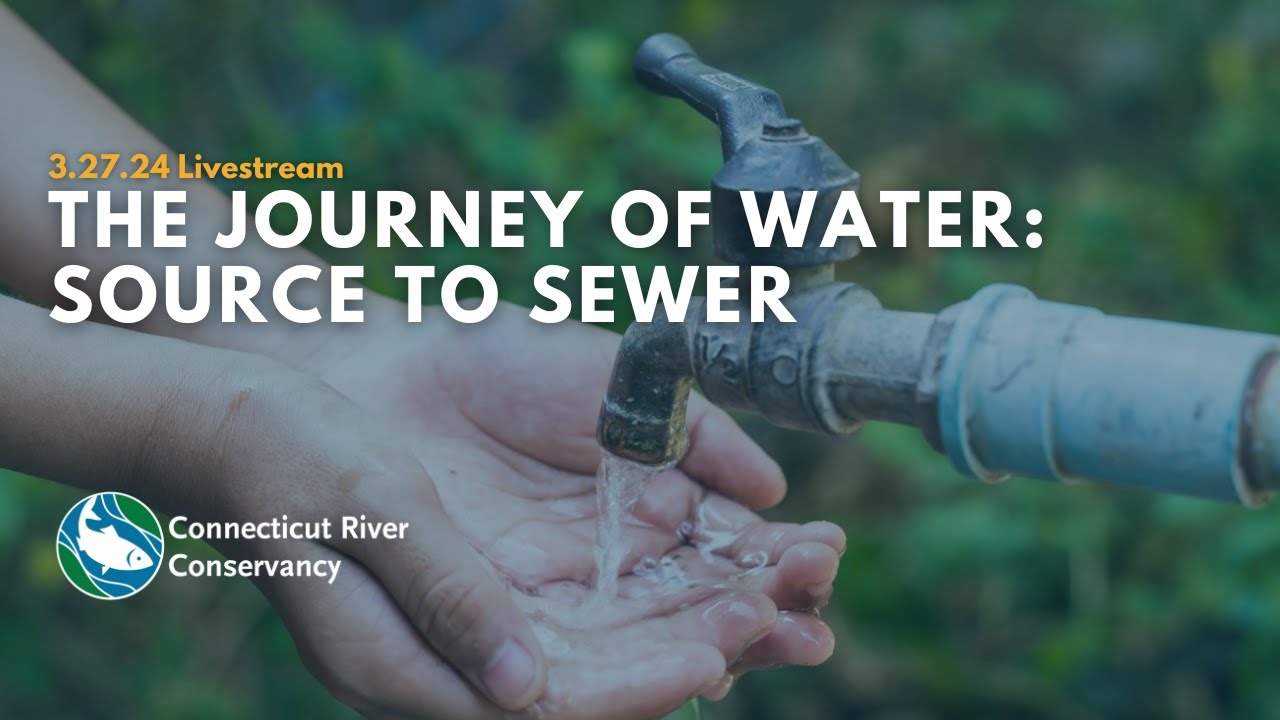
- LiveStream: The Journey of Water from Source to Sewer
Streamed 3/27/24 Where does your water come from and where does it go? From wells and reservoirs to wastewater treatment plants and stormwater solutions, discover the journey water takes from source to discharge. Nina Gordon-Kirsch, River Steward in MA, and Rhea Drozdenko, River Steward in CT spoke about the impacts of climate change on the Connecticut River Valley’s local water sources and the occurrences of sewage overflows into the River. Nina and Rhea help uncover what municipalities are doing to cope with these issues and invite the public to be part of the solution via individual actions. _____________________ About LiveStream: CRC brings your rivers to you! Join CRC staff and partners for a series of live lunchtime presentations, on select Wednesdays from Noon-1pm. You get to learn more about the rivers you love, ask questions, and interact with a river-loving community all from the comfort and safety of your home (or wherever you may be). LiveStream will be hosted via Zoom. Please register for each presentation to receive meeting information. See past, present and future events in our LiveStream series. Check out CRC's Events Calendar to learn about other upcoming events.
- CRC comments on the Sugar River Dam II (P-15003/ Previously P-10934) PAD and Study Plan Requests
January 13, 2020 Ian Clark New Hampshire Renewable Resources 65 Ellen Ave. Mahopac, NY 10541 Re: CRC comments on the Sugar River Dam II (P-15003/ Previously P-10934) Preliminary Application Document and Study Plan Requests Dear Mr. Clark, The Connecticut River Watershed Council, Inc. (CRWC), now doing business as the Connecticut River Conservancy (CRC), is a nonprofit citizen group established in 1952 to advocate for the protection, restoration, and sustainable use of the Connecticut River and its four-state watershed. The interests and goals represented by CRC include, but are not limited to, improving water quality; enhancing habitat for fish and other aquatic biota; safeguarding and improving wildlife habitat; protecting threatened and endangered species; protecting wetlands; preserving undeveloped shore lands; enhancing public recreation and promoting recreational safety; protecting aesthetic values; protecting archeological, cultural, and historical resources; fostering sustainable economic development; and maintaining the potential energy benefits of hydroelectric projects in the Connecticut River watershed. CRC attended the Joint Agency and Public meeting on November 14, 2019 and has reviewed the Sugar River Dam II hydro-electric facility Pre-Application Document dated August 6, 2019. Please consider our comments on the PAD and requested studies below. 3.3 PROJECT FACILITIES During the site visit it was clear that there was a bypass reach. There is no description of the bypass reach in the project facilities section. 3.3.4 INTAKE STRUCTURES What is the correct spacing of the grates on the trash rack? The Eagle Times Notice dated August 6, 2019 indicates that, “The project includes a downstream fish passage facilities consisting of a by-pass flume and 1-inch clear spaced trash-racks at the power intake,“[1] but the PAD indicates, “The intake has a steel trash rack to prevent debris and large fish from entering the penstock. The grates are spaced ¾ in apart.”[2] 3.5.1 CURRENT LICENSE REQUIREMENTS The applicant describes many of the articles in the current license, but does not provide a copy of the license in the PAD. Additionally, there is no indication in the PAD if the applicant has complied with license requirements and no documentation of that compliance. For instance: “Article 401, as amended, approves a filed erosion and sediment control plan that is made a part of the license.”[3] This erosion and sediment control plan should be included in the PAD and actions pertaining to it should be described. “Article 402 requires the licensee to operate in an instantaneous run‐of‐river mode for the protection of fish and wildlife resources and act at all times to minimize the fluctuation of the reservoir surface elevation.”[4] The PAD does not provide for any evidence of surface water elevation monitoring at the facility. “Article 404 requires the licensee, after consultation with Federal and State resource agencies, to develop a final plan to install streamflow monitoring equipment to monitor compliance with Articles 402 and 403… requires the licensee to develop a final plan to install streamflow monitoring equipment to monitor compliance with Articles 402 and 403 to include at least two flow gages at the project, one at the location upstream of the project and one gage downstream of the tailrace.”[5] There is no indication in the PAD of whether this was done or how streamflow is monitored. If gages have been installed, please include gage information for the project since installation. Flow duration curve information is provided, but it is not clear where this information was derived from. “Article 405, as amended, requires the licensee to install, operate and maintain the angled trash rack and downstream fish passage and install a 3‐foot‐deep plunge pool to ensure safe passage of downstream fish migrants.”[6] During the site visit, Mr. Nolan indicated that the angled trash rack was installed, but was the plunge pool installed? Is there documentation of this? “Article 408, as amended, requires the licensee to file a plan to improve recreational access to the impoundment and bypass reach by maintaining the existing parking area on the north bank of the impoundment and by obtaining agreements and/or easements from abutting landowners for access points on the north and south shores of the bypass reach.”[7] Was a plan filed or were any agreements or easements obtained from abutting landowners? “Article 410 requires the licensee to file a dissolved oxygen (DO) and water temperature (water quality) monitoring program plan.”[8] Has a program been put in place and are there any water quality monitoring results? The only water quality monitoring referred to in the PAD is that done by the VRAP program possibly in 2009 (based on the reference on page 47)[9]. 3.5.4 PROJECT COMPLIANCE HISTORY The applicant indicates that, “The Form 80 was filed on July 1, 2016 with a waiver requested for not filing future reports”[10] but a search of the FERC record indicates that FERC requested additional information in October of 2017[11] to evaluate the waiver request. Was this additional information filed with FERC? The PAD indicates a draft Operations and Compliance Monitoring Plan (OCMP) would be circulated for agency comment in 2016.[12] Was this ever done and put in place? 4.1.4 RESOURCE PROTECTION The PAD states, “The Project operates in a run‐of‐river mode with a minimum flow of 15 cfs, and 20 cfs, per license Article 403, from Sugar River II Dam. By operating in a run‐of‐river mode, the Project minimizes large fluctuations of flow in downstream reaches. (Note: Sugar River I Project has a 37 cfs minimum flow condition.)”[13] Since the licensee is the owner of both facilities, how are the minimum flows coordinated between the two dams? 4.5.2 WILDLIFE The PAD states, “downstream exist records of wood turtles and brook floater mussels.”[14] Wood turtles are a species of special concern in NH and the Brook Floater is a state endangered species. We support the agencies’ study requests for a mussel survey. CRC would also encourage FERC and the natural resource agencies to consider a wood turtle survey to support the protection of this species and evaluate the presence or absence of wood turtle or appropriate habitat below the tailrace and along the bypass channel. 4.8.2 RECREATION OPPORTUNITIES IN THE PROJECT VICINITY The PAD states, “The project boundary is often used for fishing by local residents.”[15] Form 80 submitted for the 2015 year indicate that there were at least 50 people annually who used the site for recreation, and approximately a peak weekend average of about 5 persons. For a small community, this is a significant amount of use of the area. Additionally, this use is occurred without the presence of inviting public amenities. For instance, there are no picnic tables, or clearly marked parking spots indicating to the public that they can use the area for fishing, bird-watching, or walking, etc. The property around the hydro facility encompasses two large fields owned by the licensee which might be accessed for ball playing, picnicking, or fishing with access to the river. FERC issued a letter on October 4, 2017 requesting that the licensee, “provide documentation of how recreation use data was gathered, including the dates, hours, and locations sampling occurred and the methods used to gather count data (e.g. electronic counters, staff observation, surveys) to support the report of less than 50 recreation days at the project for the year.”[16] Based on the FERC docket it seems that no follow-up was done regarding this request. Given this, ideally, the applicant would do a recreation study to understand the full extent of recreational use in the project area. The FERC guidance for recreation at hydropower projects states, “Licensees must also keep in mind that the demand for recreation is not static; it is an evolving process. Periodic review of a project’s consistency with recreation demands is required to ensure that the public need for recreational opportunity is being met by existing and proposed facilities.”[17] Additionally, the PAD indicates that, “The town (of Newport) has an interest in promoting outdoor recreation and protecting the Sugar River corridor.”[18] While we understand that there may be limited recreational opportunity at the facility itself, the presence of the dam (and the Sugar River I dam) nevertheless impedes access by anglers, boaters and other recreation users to freely access or paddle through on the river. Given this, CRC encourages NHHR to make a commitment to develop a recreation study to fully understand the extent of use of the project area and a Recreation Plan with a commitment to update this every 10 years over the course of the license in case additional opportunities for recreational improvements arise. See Requested Study 1 in Attachment A. In addition to the comments provided above, please note that CRC supports comments submitted by the natural resource agencies, including but not limited to the New Hampshire Fish and Game Department (NHFGD), NH Department of Environmental Services, and the U.S. Fish and Wildlife Service (USFWS). Specifically, in addition to our formal Recreation Survey Study request enclosed herein, we also request and support the studies on Water Quality, Mussel survey, Instream Habitat Mapping and Bypass Flow Assessment as outlined by the natural resource agencies. We appreciate the opportunity to provide comments. I can be reached at kurffer@ctriver.org or (802) 258-0413. Sincerely, Kathy Urffer River Steward Encl: Attachment A: Study Requests CC: FERC, e-file Paul Nolan, NHRR LLC (pvnpvndiver@gmail.com) Ian Clark, NHRR (ianc@dichotomycapital.com) Gregg Comstock, NHDES Melissa Grader, US FWS NHDES, Carol Henderson NHDES, Matt Carpenter ATTACHMENT A: STUDY REQUESTS Requested Study 1: Recreation Survey Conduct a study of the recreational fishing and birding opportunities at the dam, as well as upstream and downstream of the dam including the bypass, to determine if changes or improvements can be made to enhance recreational opportunities. Methodology should include using on-site visitor questionnaires and a mailed and/ or emailed questionnaire to residents of Newport adjacent to the project to assess recreation use and needs at the project. The study should also include an assessment of ADA compliant fishing access from the parking lot and walking paths available in the project area. Goals and Objectives To determine if project operations impact recreational opportunities; To determine current use of project area for recreation; Assess if there are operational, structural or other modifications to the project which could improve fishing, birding, or other recreational opportunities. Resource Management Goals Enhancement of recreational opportunities associated with the presence and operation of the project, including the dam, reservoir and tailwater areas. Noted that requester is not an agency or Indian tribe. Public Interest Sections 4(e) and 10(a) of the Federal Power Act require the Commission to give equal consideration to all uses of the waterway on which a project is located, and what conditions should be placed on any license that may be issued. As indicated in the FERC guidance for Recreation Development at Licensed Hydropower Projects, “On December 27, 1965, FERC issued Order No. 313, which amended the General Policy and Interpretations section of the Commission’s regulations (18 CFR Part 2) to ensure that the ultimate development of recreation resources at all projects is consistent with area recreational needs. Specifically, 18 CFR Part 2 was amended to include § 2.7, which requires licensees to: (1) acquire lands to assure optimum development of the recreational resources afforded by the project; (2) develop suitable public recreational facilities with adequate public access, considering the needs of physically handicapped persons in the design of facilities and access; (3) coordinate efforts with other agencies in the development of recreation areas and facilities; (4) provide for planning, operation, and maintenance of these facilities; and (5) inform the public of opportunities for recreation at licensed projects.”[19] Existing Information Other than the 2015 Form 80 report filing, little information exists as to current use of the project area. Based on the lack of response to FERC’s request regarding the waiver request in this filing, the information provided may be marginal in validity. Current lack of signage and physical status of the project area may limit recreational opportunities by discouraging access. This needs to be assessed. Nexus to Project Operations and Effects Boaters, anglers, and other recreational users are impeded from access to their public trust waters by hydro-electric dams. Changes in hydraulic conditions and habitat in the river impacts their ability to use the resources, affects catch rates and species for fish, and creates safety concerns. Current project lands in a heavily populated area might be made available for public use at little cost. Methodology Consistent with Accepted Practice The proposed study would be conducted by using on-site visitor questionnaires and a mailed and/ or emailed questionnaire to residents of Newport to collect feedback on perceptions of access to the area, use patterns and local needs. This is an accepted methodology for this type of study. Level of Effort/Cost, and Why Alternative Studies will not suffice Cost for this study is estimated to be low. This study would provide the current baseline regarding recreational use and would provide insight into the need for and type of potential enhancements. ~~~~~~~~ [1] Nolan, Paul V. ‘Public Notice of NOI and PAD.’ The Eagle Times, Claremont, NH. Tuesday, August 6, 2019. B9. [2] Pre-Application Document. Sugar River II Hydroelectric Project. FERC Project No. 10934. Prepared for New Hampshire Renewable Resources, LLC. August 6, 2019. Page 9. [3] Pre-Application Document. Sugar River II Hydroelectric Project. FERC Project No. 10934. Prepared for New Hampshire Renewable Resources, LLC. August 6, 2019. Page 12. [4] Ibid. Page 12. [5] Ibid. Page 13. [6] Ibid. Page 13. [7] Ibid. Page 13. [8] Ibid. Page 13. [9] Ibid. Page 47. [10] Ibid. Page 14. [11] Ivy, Mark I on behalf of FERC “Requirement to File FERC Form No. 80.” Received by Ronald K. DeCola. Dated October 4, 2017. [12] Pre-Application Document. Sugar River II Hydroelectric Project. FERC Project No. 10934. Prepared for New Hampshire Renewable Resources, LLC. August 6, 2019. Page 15. [13] Ibid. Page 16. [14] Ibid. Page 26. [15] Ibid. Page 34. [16] Ivy, Mark I on behalf of FERC “Requirement to File FERC Form No. 80.” Received by Ronald K. DeCola. Dated October 4, 2017. [17] Recreation Development at Licensed Hydropower Projects: Division of Project Compliance and Administration, Office of Hydropower Licensing, Federal Energy Regulatory Commission, Washington DC. March 1996. Page 14. [18] Pre-Application Document. Sugar River II Hydroelectric Project. FERC Project No. 10934. Prepared for New Hampshire Renewable Resources, LLC. August 6, 2019. Page 35. [19] Recreation Development at Licensed Hydropower Projects: Division of Project Compliance and Administration, Office of Hydropower Licensing, Federal Energy Regulatory Commission, Washington DC. March 1996. Page 1.