Community Effort, Lasting Impact: Tackling Aquatic Invasive Species Across the Connecticut River Watershed

Across the multi-state watershed, the Connecticut River Conservancy's (CRC) Aquatic Invasive Species (AIS) Program works to protect the health of the Connecticut River through a combination of prevention, monitoring, awareness, and direct management. While water chestnut removal remains a hallmark of CRC's work in the southern watershed, our efforts upstream focus on preventing new infestations and detecting emerging threats before they become widespread. Together, these complementary strategies help safeguard thousands of watershed acres while engaging hundreds of community members to this effort.
Water chestnut management in Connecticut and Massachusetts
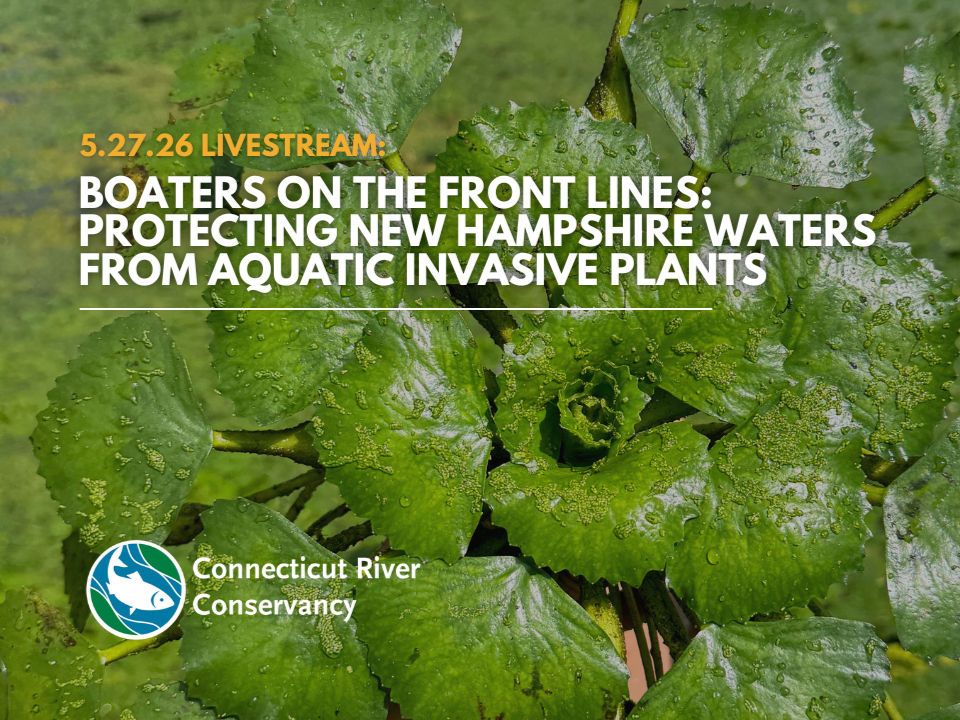
In Connecticut and Massachusetts, hundreds of volunteers joined CRC staff and community partners this season to remove invasive water chestnut (Trapa natans), a fast-growing aquatic plant that forms dense floating mats capable of choking waterways, limiting recreation, and degrading habitat. Across Connecticut sites including Keeney Cove, Floating Meadows, Whalebone Cove, and Addison Pond, volunteers and staff removed an estimated 218,000 water chestnut rosettes while restoring access and improving ecological conditions. Keeney Cove alone accounted for more than 25,000 pounds of removed material, with 135 volunteer participations contributing over 470 volunteer hours.
Partnerships remain at the heart of this work. CRC collaborated closely with organizations including the Jonah Center for Earth and Art, Middletown Pride, municipal agencies, neighborhood groups, and individual landowners. At Addison Pond in Glastonbury, local residents helped launch a rapid response effort after a previously unmanaged infestation was discovered late in the season. Community members provided access, equipment, and volunteer support, enabling CRC to remove nearly 5,000 pounds of water chestnut in just a few weeks.
In Massachusetts, CRC and local partners focused on continued work and new collaborations at sites like Lake Warner, the Oxbow, Oxford Marsh, Bachelor Brook, Log Pond Cove, and the Fannie Stebbins Wildlife Refuge. One of the season's most notable successes occurred at Lake Warner, where volunteers and staff worked alongside Friends of Lake Warner & the Mill River to combine volunteer handpulling with a new Truxor aquatic

vegetation harvester. We also hosted our first ever Massachusetts Paddle with Pride event with Friends of Lake Warner and welcomed a new partnership with The Venture Out Project. We welcomed a reinsurance of collaborative work with Friends of Fannie Stebbins, Mass Audubon Arcadia Wildlife Sanctuary, and Chicopee 4Rivers. Together, these efforts removed an estimated 130,000+ water chestnut plants and over 20,000 pounds of biomass in MA, demonstrating how innovative tools and community stewardship can work together to address large infestations.
Prevention and early detection in Vermont and New Hampshire
Further north, the challenges look different. In Vermont and New Hampshire, CRC's AIS Program focuses primarily on prevention, early detection, and monitoring rather than large-scale water chestnut removal. Working alongside the Vermont Department of Environmental Conservation, New Hampshire Department of Environmental Services, NH Lakes, and local conservation partners, CRC helps expand prevention, early action, and community awareness initiatives. CRC works to conduct boater surveys and courtesy boat checks at public access points with aquatic plant surveys in coves along the main stem of the Connecticut River between southern Vermont and New Hampshire. These surveys provide important monitoring data and community awareness which are particularly important for detecting emerging threats such as hydrilla. While not found further north than Agawam in Massachusetts, hydrilla is one of the most aggressive aquatic invasive plants in the watershed and is spreading fast. Early detection of aquatic plants allows watershed partners to act quickly to prevent costly, long-term infestations.
The CRC field staff in Vermont & New Hampshire benefit from training and resources through vital programs such as the Vermont Public Access Greeter Program, Vermont Invasive Patrollers, and the NH Lakes Lake Host Program. Weed Watcher Programs provided by state departments such as New Hampshire and Massachusetts have also become valuable for our northern watershed field staff and volunteers this year. These programs support organizations like CRC and volunteer community members to identify invasive species before they spread to new waterways. The CRC AIS program is proud to partner as a participant and support these programs as foundations for preventive and early detection measures across Vermont and New Hampshire!
Long term management and community stewardship
Water chestnut management remains part of the CRC northern program as well. CRC supports the Windham County Natural Resources Conservation District and its Kayak for Conservation program in Vermont and New Hampshire, where years of dedicated hand-pulling have dramatically reduced water chestnut populations near the towns of Vernon, Hinsdale, Rockingham, and North Walpole. Today, only small numbers of plants are being found, highlighting the long-term value of sustained management and monitoring. This is a direct result of local leaders and the WCNRCD dedicated effort to reduce the impact of water chestnut in southern Vermont of New Hampshire!
Whether removing thousands of pounds of water chestnut in Connecticut and Massachusetts or monitoring for new invasive species in Vermont and New Hampshire, CRC's AIS Program relies on a simple principle: local action creates watershed-wide impact. We look forward to growing the AIS program to reach other areas of the watershed with our volunteer organization and spread awareness in the years to come. Thanks to the dedication of volunteers, partner organizations, municipalities, and state agencies throughout the four-state watershed, the Connecticut River is becoming more resilient to invasive species threats and better protected for future generations.